Every summer in Tucson feels like a pressure test for air conditioners. Temperatures routinely climb into triple digits, and a small leak or failed capacitor can turn a cool home into an oven in hours. For homeowners looking for reliable AC repair in Tucson, understanding the tools technicians bring to a job clarifies why certified HVAC contractors charge what they do, and why calling an experienced HVAC company near me often saves money and time over DIY fixes.
I’ve spent years in service vans, swapping filters at dawn and diagnosing intermittent failures at dusk. What follows is a trade-focused, practical guide to the tools that matter most on an AC service call. I include why each tool is used, what good technicians look for, and how tool choice affects outcomes like speed, safety, and system longevity. If you ever type HVAC Service Near Me or Emergency AC repair near me into a search box, this piece helps you ask smarter questions and recognize competent technicians.
Why tools matter more than brand names Tools do the work, but seasoned techs use tools as extensions of judgment. Two technicians can have the same wrench set and produce very different results. Good tools minimize guesswork and keep repairs focused. For example, a clamp meter with inrush current capability lets a tech decide in minutes whether a compressor is drawing too much current on startup, instead of relying on trial and error that can stress components. That saves a compressor and the homeowner hundreds or thousands of dollars.
Essential diagnostic instruments Accurate diagnosis beats replacement. Modern HVAC systems combine electrical, mechanical, and refrigerant systems; a wrong move in one area can cascade into failures in another. The first set of tools good technicians reach for are diagnostic instruments that answer the fundamental questions: electrical integrity, refrigerant condition, airflow, and temperature balance.
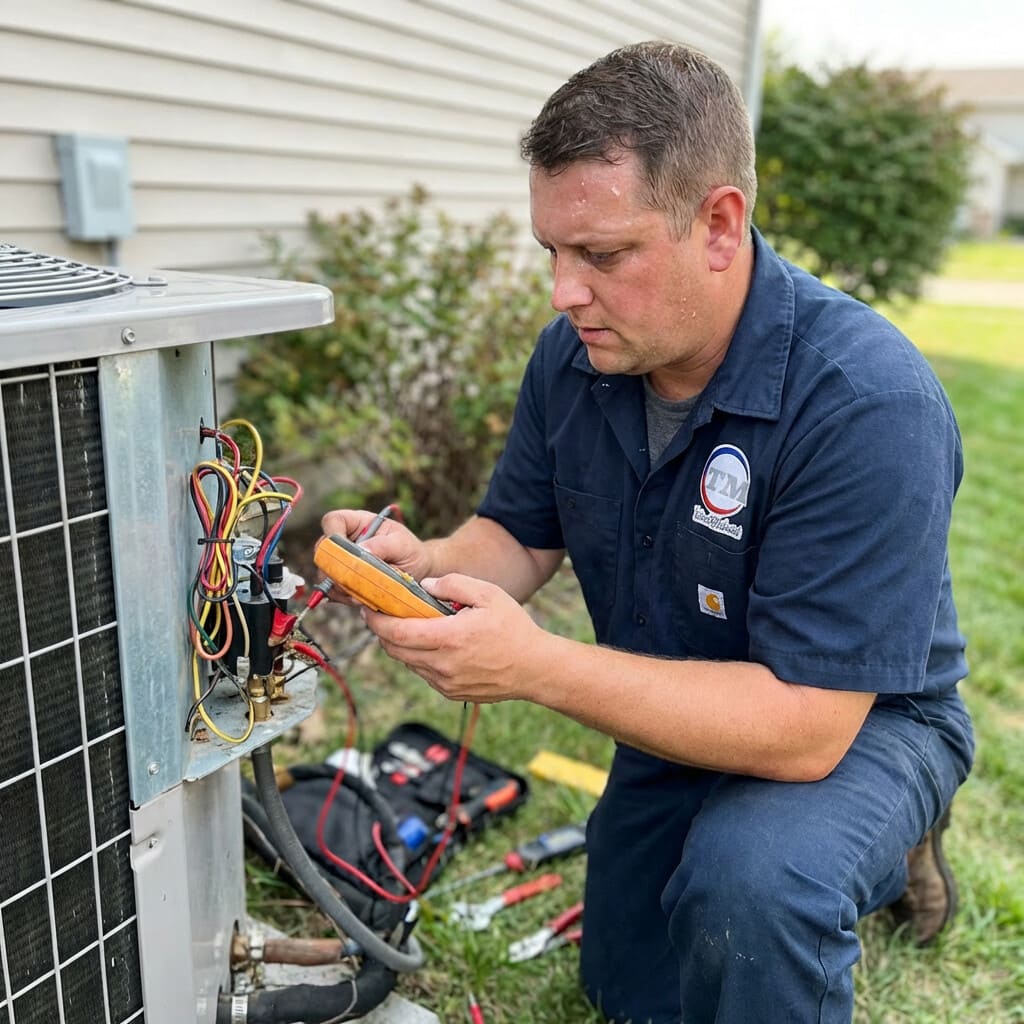
Digital multimeter A reliable digital multimeter is arguably the single most used item on service calls. Beyond checking voltage and continuity, experienced techs depend on it to:
- verify correct line voltage at the disconnect, measure thermistor and capacitor functionality, check contactor operation under load.
Look for meters with true RMS readings and a decent input impedance to avoid false readings on modern electronics. Cheap meters can mislead on subtle voltage drops that cause motor overheating. A competent HVAC contractor will bring more than one meter: a handheld DMM for quick checks and a benchtop quality meter for detailed troubleshooting when necessary.
Clamp meter with inrush measurement Typical clamp meters only show running current, which can miss problems that occur only at motor startup. A clamp meter that measures inrush current detects locked rotor or heavy-start conditions on compressors or fans. If a compressor draws two to three times the normal running current at startup, it signals mechanical binding, low voltage, or failing start components. Measuring inrush saves both time and expensive misdiagnoses.
Manifold gauges and refrigerant scales Diagnosing refrigerant problems is where manifold gauges still matter. Technicians use them to measure high and low side pressures and to determine if a system is undercharged, overcharged, or suffering restriction. Pairing gauges with a refrigerant scale allows accurate charging by weight, which is critical to meet manufacturer specifications. Guessing by sight or relying solely on pressures without considering ambient temperature and superheat/subcooling often leads to improper charge.
Digital refrigerant analyzers When gas purity matters, a refrigerant analyzer helps. Contaminants such as air or moisture change pressure readings and harm compressors. An analyzer prevents adding new refrigerant to a contaminated circuit and guides evacuation and recovery decisions. In regions like Tucson, where system longevity relies on clean operation through prolonged summer cycles, this can be the difference between a short-term patch and a permanent fix.
Infrared thermometer and thermal imaging Temperature differentials tell stories. A handheld infrared thermometer gives instant readings across evaporator coils, supply and return ducts, and capacitor surfaces. Thermal imaging cameras expand that capability, revealing hot electrical connections, blocked coils, or failing bearings before they fail catastrophically. I once caught a partially loose lug on a condensing unit https://lanepsep310.image-perth.org/signs-you-need-hvac-service-near-me-in-tucson contactor with a thermal camera; the technician who tightened it likely prevented a house fire and a week-long outage.
Airflow measurement tools AC performance is as much about moving the right air as it is about refrigerant. An anemometer and static pressure probe help technicians quantify airflow issues. Dirty coils, undersized ductwork, and failing blowers often present as inadequate cooling despite normal refrigerant pressures. Measuring face velocity at supply grilles and static pressure across filters tells whether the problem is the system itself or the ductwork and zoning.
Hand tools that separate pros from beginners A quality set of HVAC hand tools speeds work and reduces collateral damage. The difference between a stripped screw and a clean removal can cost minutes or hours on a job.
Tubing benders and flaring tools Properly bent copper without kinks maintains refrigerant flow. Flaring tools make gas-tight fittings for service valves. Skilled techs use benders to route lines neatly and minimize future vibration wear. Improperly flared or kinked lines lead to leaks that show up during the hottest week of the year.
Vacuum pumps and micron gauges Pulling a deep vacuum and measuring it in microns ensures moisture and non-condensables are out of the system. A vacuum pump alone is not enough; micron gauges verify the level. Technicians who skip this step risk trapped moisture that forms acids when mixed with refrigerant oil, leading to premature compressor failure. For systems repaired in Tucson, where humidity fluctuates, proper evacuation protects expensive components.
Refrigerant recovery units Environmental regulations and safety require technicians to recover refrigerant rather than venting it. A dedicated recovery machine stores refrigerant for reuse or proper disposal. Using an inadequate recovery method can leave residual gas in a system or violate local codes. Responsible HVAC contractors, including Plunkett Home Services and similar reputable firms, always bring certified recovery equipment.
Mobile parts and inventory A well-stocked van keeps small fixes from turning into multiple site visits. Technicians commonly carry a range of capacitors, contactors, hard-start kits, refrigerant driers, thermostats, and common motors. A single van visit that replaces a failed capacitor and cleans coil fins can be a huge value to a homeowner compared with the downtime and labor of a follow-up trip.
Small consumables like O-rings, brazing rods, solder, flux, Teflon tape, and a small compressor relay can shorten repair time dramatically. Expect a professional HVAC contractor to show up with consumables sized for the typical systems in your area.
Safety gear and specialty items HVAC work involves electricity, pressure, and chemicals. Personal protective equipment is not optional.
Gloves, eye protection, and arc flash-rated clothing where appropriate protect technicians during live testing. Refrigerant-resistant gloves and nitrile guards prevent skin exposure during handling. Gas leak detectors are essential when systems smell of refrigerant or when brazing near flammable insulation. Portable carbon monoxide monitors are common on service calls where furnaces coexist with AC systems.
A good tech also brings a brazing kit, flame arrestors, and nitrogen tanks for pressure testing during brazing. Purging with nitrogen prevents oxidation and keeps joints clean.
How tool choice changes outcomes Selecting a technician based on tools and technique, rather than price alone, pays off. A contractor who arrives with manifold gauges, a proper recovery unit, a micron gauge, and a thermal camera will diagnose and fix most problems in a single visit. That reduces downtime, lowers the risk of repeat failures, and gives you documentation for warranties.
There are trade-offs. For example, a technician might recommend replacing a system rather than repairing it. If the system is old, chargers and compressors have been patched multiple times, and SEER performance is low, replacement can be cost-effective. However, replacing components prematurely wastes money and resources. The judgment lies in balancing immediate repair costs, expected remaining life, and the homeowner’s tolerance for future service.
Two short checklists to help homeowners evaluate a tech on site Checklist 1: Questions to ask a technician before they start work
- What tools will you use to diagnose the problem? Will you perform a refrigerant recovery if refrigerant needs removal? Can you measure the system in microns after evacuation? Do you stock replacement parts for immediate repair? Is there a warranty for parts and labor, and how long does it last?
Checklist 2: Red flags that suggest a technician is not prepared
- No manifold gauges or they use only quick-connect gauges with unknown calibration. No recovery unit when refrigerant removal is required. Refusal to measure current, voltage, or superheat/subcooling. Reliance on guesswork such as adding refrigerant until cooling "feels right" without measurements. No documentation or explanation of the diagnostic findings.
Real-world examples and trade-offs Example 1, a frozen evaporator coil and a rushed fix. I once responded to a home where the evaporator coil repeatedly froze despite multiple charge adjustments by a different company. The prior tech added refrigerant several times without measuring airflow. The real issue was a blocked return duct and a failing blower motor. Recharging temporarily helped because more refrigerant compensated for lower heat load, but the root mechanical problem remained. After addressing the airflow and replacing the motor, the system ran at specified superheat and used less energy. Lesson: tools that measure airflow and electrical draw reveal problems that gauges alone do not.
Example 2, the failing capacitor in a heat wave. Capacitors are cheap compared with compressors. A homeowner saved over $700 by hiring a tech who brought a capacitor meter and replaced a failing run capacitor that had caused the compressor to cycle dangerously. The test took five minutes and the fix took twenty. That is the pragmatic value of accurate tools and quick judgment.
Hiring an HVAC contractor in Tucson: what to expect When you call for AC Repair in Tucson or search HVAC contractor, expect technicians to ask about the symptoms and recent service history. Good contractors will schedule an on-site diagnostic rather than promising a price over the phone. Transparent companies provide a written estimate listing parts, labor, and any warranty terms. They explain the trade-offs openly: a repair with a six-month warranty, a repair with a two-year warranty, or a full replacement with manufacturer warranty and financing options.
Emergency AC repair near me searches spike during heat waves. During those times, expect response priorities: life-safety issues and households with infants or elderly are typically prioritized. A reputable local outfit like Plunkett Home Services often maintains bigger inventories and rapid-response teams for emergencies. That readiness rests on having the right tools in multiple vans, plus trained technicians who know when to repair and when to recommend replacement.
Maintenance tools worth mentioning Routine maintenance prevents many service calls. Technicians use coil cleaners, fin combs to straighten fins, and high-quality filters. They test thermostats, inspect drain lines, and measure static pressure. A system serviced regularly is less likely to require emergency AC repair near me and tends to live longer, especially under Tucson’s relentless summer load.
Final practical advice for homeowners Ask for a walk-through of the findings. A credible technician can show refrigerant pressures, temperature splits, electrical readings, and thermal images. Request to see replaced parts; a blown capacitor or a burnt contactor is tangible proof that work was necessary. Keep records of service calls, dates, and invoices. They help establish a maintenance pattern and are useful if you later sell the home.
When evaluating quotes, compare like for like. Cheaper initial bids can omit proper evacuation and recovery, use salvaged refrigerant without analysis, or install inferior replacement parts. Those practices can lead to higher lifetime costs and system breakdown during the hottest week of the year. Pay for proper diagnosis and the right tools up front, and you buy reliability.
A technician’s toolbox reflects their professionalism. The right instruments save time, reduce risk, and protect expensive components. Whether you need AC Repair in Tucson, Ac installation in Tucson, or an HVAC company near me for routine checks, prioritize contractors who bring measurement, recovery, and safety gear to each job. That approach keeps your home comfortable, your energy bills predictable, and your system running longer.
If you want recommendations, local providers with strong reputations and documented diagnostic practices can make all the difference during peak season. Choosing a contractor who clearly explains tools, shows measurements, and backs work with warranties prevents most summertime headaches.

Plunkett Home Services
3144 E Fort Lowell Rd, Tucson, AZ 85716, United States
+1 (520) 808-2743
[email protected]
https://callplunkett.com/